Local-first AI engineering as leverage
The point of an AI engineering platform is not to own the biggest laptop, the newest GPU, or the most complicated cloud account. The point is leverage: building systems that increase the amount of useful economic and technical output one engineer can produce.
That distinction matters. If every new project starts by choosing a model vendor, a machine, a database, and a deployment target from scratch, the work does not compound. It resets. A better platform lets applications ask for capabilities instead of infrastructure.
The application should not need to know whether a model call runs on a local GPU, a home inference server, AWS, Anthropic, OpenAI, or another provider. It should ask for inference with a policy: privacy, cost, latency, quality, reliability. The platform should decide where the work belongs.
Local-first does not mean cloud-hostile. It means local infrastructure is the default when it gives better privacy, cost control, experimentation speed, or ownership. Cloud earns its place when it provides uptime, elasticity, managed services, public endpoints, or capabilities that are not worth recreating locally.
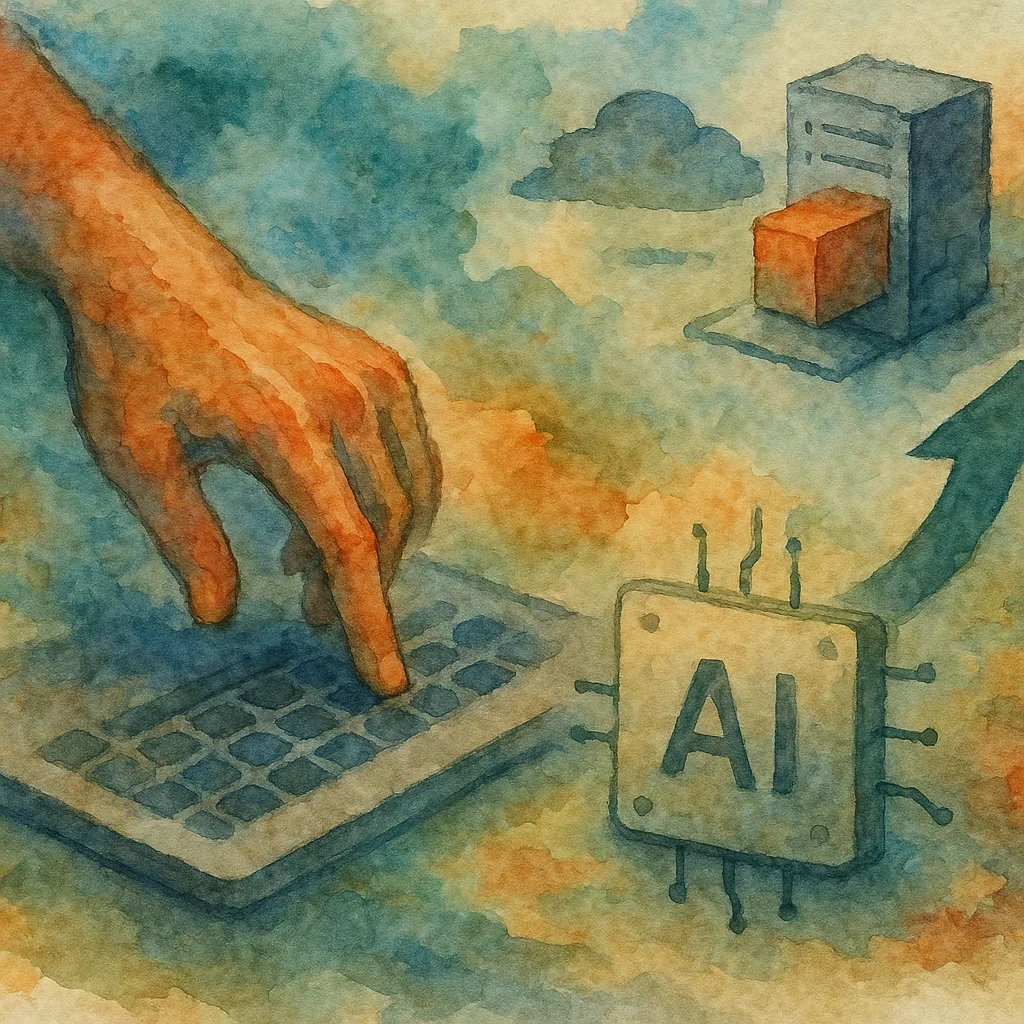
The laptop becomes the cockpit. It is where development, orchestration, review, and design happen. It does not need to contain every ounce of compute. Compute is a resource: sometimes a local GPU, sometimes a home server, sometimes a managed model API, sometimes AWS. The interface should remain stable while the implementation changes underneath.
This is also the right mental model for agents. The product is not the server, the GPU, or the container stack. The product is the workflow: agents that can research, code, analyze, test, monitor, and escalate. Infrastructure exists to support those workflows. It should not become the center of gravity.
Autonomy without evaluation is dangerous, so the platform has to grow in the right order. First, preserve state. Then make the local control plane boring. Then add service primitives: object storage, databases, vector search, routing, monitoring. Then add capability APIs. Then build agents behind tests, logs, cost measurements, failure categories, and human escalation policies.
The long-term business case is straightforward. Small and medium businesses have real knowledge-work problems: documents, reporting, extraction, research, operational monitoring, construction/project analysis, and workflow coordination. Most cannot justify a large internal AI team. A repeatable AI engineering platform can deliver practical systems for those businesses without pretending that one model or one vendor is the whole solution.
The rule is simple: do not sell magic. Sell measurable leverage.
A good platform should make one engineer more capable this month than last month. It should preserve the lessons, abstractions, and workflows that worked. Hardware will change. Model providers will change. Cloud services will change. The interface should remain.
Build systems that make useful work compound.