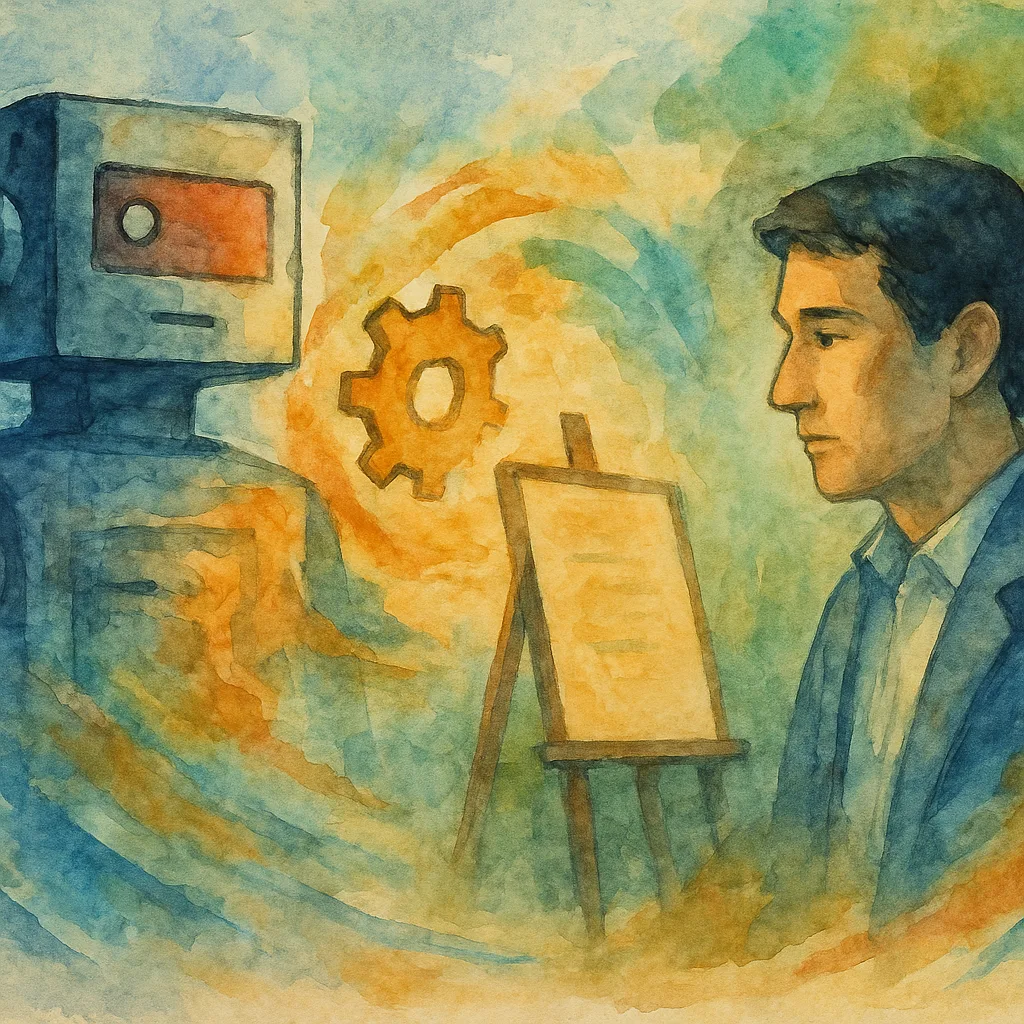
After Automation: Why AI Creates More Expert Human Work
[!summary] Based on Dan Shipper’s Every essay, “After Automation.” The core argument is counterintuitive: as AI automates more work, expert human work does not disappear. It shifts toward framing, judgment, supervision, taste, differentiation, and system-building.
The standard AI story says automation removes work.
Dan Shipper’s argument in Every’s “After Automation” is more interesting: automation removes certain tasks, but creates more demand for the humans who know what the work is supposed to become.
That sounds paradoxical until you look closely at what AI is actually good at. AI can reproduce a huge amount of existing knowledge work. It can draft, summarize, classify, code, answer, route, and imitate. But the more it can do those things, the less valuable the default version of those outputs becomes.
When competence becomes cheap, difference becomes valuable.
And difference still comes from humans: from taste, context, judgment, relationships, domain expertise, responsibility, and the ability to decide what matters.
The central paradox
Every is a useful case study because the company has aggressively adopted AI across coding, writing, design, customer support, email, and internal operations.
According to Shipper, Every uses tools like Codex, Claude Code, Claude Cowork, Slack agents, customer-service agents, and agent-assisted email workflows. Yet the company has not simply replaced its humans with agents. It still hires customer service people, writers, editors, engineers, and managers.
The work changed. It did not vanish.
Engineers spend less time typing code by hand. Managers can commit code. Customer service humans spend less time answering repetitive tickets and more time improving the system. Writers and editors still matter because the problem is no longer “can we produce text?” The problem is “can we produce something worth reading?”
That is the heart of the argument:
AI commoditizes the residue of human expertise — the parts of work that have already been made explicit enough to train on. Once that residue becomes cheap, the value shifts to what is not generic.
What AI automates first
AI is strongest where the work is already legible:
- The pattern is visible in training data.
- The success criteria are easy to state.
- The task can be decomposed into steps.
- Mistakes are easy to catch.
- The output resembles something that already exists.
That makes AI extremely useful. It can take over the first draft, the first pass, the first search, the first classification, the first implementation, the first customer-service response, or the first summary.
But “first pass” is not the whole job.
In many knowledge-work roles, the valuable work moves up a level:
- From writing to deciding what is worth saying.
- From coding to deciding what should be built.
- From answering tickets to improving the product so fewer tickets exist.
- From drafting proposals to understanding the client well enough to make the proposal matter.
- From producing options to judging which option fits the situation.
Automation eats the repeatable layer. The human layer becomes more strategic.
Agents as employees
One mode Shipper describes is treating agents like employees. They can live in Slack, respond to mentions, gather information, draft proposals, summarize internal discussions, track todos, analyze metrics, or triage support conversations.
This is powerful because agents can absorb a lot of coordination and first-pass work.
But it also creates new human responsibilities:
- Someone must define the agent’s job.
- Someone must decide what tools and data it can access.
- Someone must evaluate whether its output is good.
- Someone must notice when the agent drifts.
- Someone must improve the workflow when the output is not good enough.
A bad agent is not free labor. It is a process problem wearing a chatbot mask.
The more agents a company uses, the more important it becomes to have humans who understand the work deeply enough to supervise, correct, and redesign it.
Human-agent collaboration
The second mode is direct collaboration: a human and AI working together on the same task.
This is where the work starts to feel less like “using a tool” and more like managing a very fast junior partner. The AI can generate code, prose, designs, research summaries, or operational plans. The human keeps the work pointed in the right direction.
The human contribution becomes:
- Framing the problem
- Supplying context
- Choosing constraints
- Asking better questions
- Detecting subtle errors
- Knowing when an answer is technically correct but strategically wrong
- Raising the standard for the final output
This is not passive oversight. It is active judgment.
The better the AI gets, the more leverage good judgment has.
Why more automation can mean more work
Automation creates more work when it lowers the cost of trying things.
If it becomes cheap to draft ten versions of a landing page, someone now has to decide which one is best. If it becomes cheap to prototype three features, someone has to talk to users and decide which one matters. If it becomes cheap to create a research memo, someone has to separate insight from plausible filler.
AI increases throughput. Throughput creates more decisions.
That is why the future of work may feel both automated and busier. The bottleneck moves from production to judgment.
The new scarce skills
If Shipper’s argument is right, the scarce skills after automation are not the same as before automation.
1. Framing
AI is highly sensitive to the shape of the problem it is given. A vague prompt produces vague work. A well-framed problem turns the model into leverage.
The human advantage is knowing what problem should be solved in the first place.
2. Taste
When everyone can generate acceptable output, acceptable output stops being impressive.
Taste is the ability to recognize what is sharp, true, useful, beautiful, differentiated, or strategically appropriate.
3. Judgment
Judgment means knowing when the answer is good enough, when it is dangerous, when it is missing context, and when it should not be used at all.
4. System design
The value is not just in using one model. It is in building workflows where AI output is checked, routed, logged, evaluated, and improved.
5. Accountability
Agents can produce work. They cannot own the consequences in the way a human can. In high-stakes work, accountability stays human.
Other sources that support the same argument
The Every essay is not alone. Several research and industry sources point in the same direction, though with different levels of caution.
David Autor / Stanford HAI: automation can replace or augment expertise
Stanford HAI summarized MIT economist David Autor’s argument that automation exposure is not the same thing as job loss. Autor’s point is that automation can either remove the expert part of a job or remove the rote part of a job, and those outcomes are very different.
If automation removes the expert core, wages and specialization can fall. If it removes supporting tasks, humans may specialize more deeply in the expert part of the work.
That supports Shipper’s argument: the effect of AI depends on what part of the job is automated. If AI removes drudgery, human expertise can become more valuable. If AI removes the differentiated core, the job is commoditized.
Source: Stanford HAI — Assessing the Real Impact of Automation on Jobs
Acemoglu and Restrepo: new tasks reinstate labor demand
Daron Acemoglu and Pascual Restrepo’s task-based framework is a useful economic foundation. They argue that automation has a displacement effect: it shifts tasks from labor to capital. But new task creation has a reinstatement effect: it creates new work where labor has comparative advantage, raising labor demand.
This does not mean automation is harmless. Their paper explicitly says automation can reduce labor’s share and may reduce demand when displacement outruns new task creation. But it supports the broader claim that automation is not simply a one-way path to human irrelevance. The future depends on whether new human tasks are created around the technology.
Source: Automation and New Tasks: How Technology Displaces and Reinstates Labor
Goldman Sachs: most jobs are partially exposed, so complementarity is likely
Goldman Sachs Research estimated that generative AI could expose a large share of occupations to automation, but emphasized that most jobs are only partially exposed. Their conclusion is that many jobs are more likely to be complemented than fully substituted by AI.
That aligns with the Every view: AI absorbs parts of work, while humans remain necessary for the parts that require context, integration, and judgment.
Goldman also cites historical evidence that many current occupations did not exist in 1940 and that technology-driven job creation has explained a large share of long-run employment growth. That supports the idea that new work appears around new tools.
Source: Goldman Sachs — Generative AI could raise global GDP by 7%
Microsoft Work Trend Index: human-agent teams, not just replacement
Microsoft’s 2025 Work Trend Index describes the rise of the “Frontier Firm”: organizations built around intelligence on tap, human-agent teams, and a new role for employees as “agent bosses.”
The framing is very close to Shipper’s lived example at Every. Microsoft argues that work will become AI-operated but human-led. That implies a shift in human labor toward directing agents, setting goals, managing exceptions, and judging outcomes.
Source: Microsoft Work Trend Index 2025 — The year the Frontier Firm is born
Where the argument needs caution
The optimistic version of this argument can go too far.
Automation does not automatically create better human work. It can also:
- Reduce entry-level opportunities
- Flatten junior learning paths
- Deskilling workers if they over-rely on AI
- Concentrate gains among people who already have expertise
- Create more monitoring and coordination work without more meaning
- Replace jobs where the core value was routine production
So the better claim is not “AI will create more jobs for everyone.”
The better claim is:
AI increases the value of humans who can define, judge, differentiate, and take responsibility for the work — while putting pressure on roles built mostly around repeatable production.
That distinction matters.
The takeaway
After automation, the human job is not to compete with AI at producing the average version of a thing.
The human job is to decide what should exist, why it matters, how good it needs to be, who it is for, and whether the output is trustworthy enough to use.
AI makes competence abundant. Abundant competence creates sameness. Sameness creates demand for judgment, taste, responsibility, and difference.
That is where expert human work moves.
Sources
- Dan Shipper, Every: After Automation
- Stanford HAI: Assessing the Real Impact of Automation on Jobs
- Daron Acemoglu and Pascual Restrepo: Automation and New Tasks: How Technology Displaces and Reinstates Labor
- Goldman Sachs Research: Generative AI could raise global GDP by 7%
- Microsoft WorkLab: 2025: The year the Frontier Firm is born